Swimming Fitness and Skills
The physical fitness of lifesavers has a direct impact on their ability to perform rescues, whether patrolling on poolside or on beaches and open water.
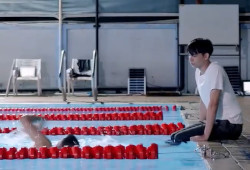
Optimal aquatic fitness training includes a warm-up followed by skills training, such as stroke length, breathing techniques, endurance and resistance swimming.
Key Fitness Points
- Proper warm-up to avoid injuries
- Correct swimming strokes
- Fun exercises like boot camp training
- Endurance swimming over longer distances
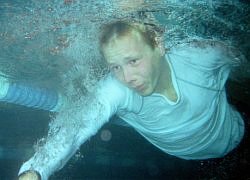
- Resistance swimming in clothes to build strength
You might spend some time swimming at race pace, like when approaching a casualty.
More often you spend a larger percentage of time swimming at a steady, endurance-level pace,
like when escorting a weak swimmer or towing a casualty.
Compound Exercises
When lifeguards do sprint training on the beach or run a fair distance, they can also include a strength training session. Upper body strength is of utmost importance to lifeguards, who have to be able to carry the weight of unconscious victims. A strong upper body needs to be balanced by a strong core and lower body.
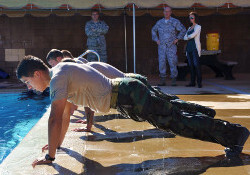
Compound exercises, also known as multi-joint exercises, train more than one group of muscles at a time. Push-ups and planks target the back, chest, shoulders, abdominal muscles, glutes and quadriceps. Other compound exercises include dips, pull-ups and dead-lifts. Most of these exercises use body weight for resistance and can also be done in the pool.
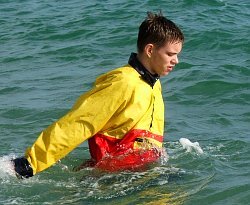
Smart beach lifeguards combine swim and run workouts, going in and out of the water often.
100m run, 100m swim, push-ups, sit-ups, repeat.
Ongoing Swim Training
After completed lessons you can enjoy advanced ongoing swim training to increase and broaden your skills. Maintaining swimming skills after lessons is crucial for several reasons:
- Regular practice helps improve muscle memory and coordination,
which are essential for safe and efficient swimming.
- Staying active in the water can help build endurance and physical fitness.
- Consistent practice allows you to retain what you've learned from your lessons, ensuring that you don't forget important techniques or safety procedures.
Especially young children should maintain their practice and their proficiency, or risk impairing the skills acquired in the water or even lose them. Clearly therefore the safety of the child is then no longer assured.
You don’t need to be a seasoned swimmer to start off, but you need to start off to become a seasoned swimmer. Depending on your swimming experience so far, you can choose a training level that is appropriate for you. Then get into the pool, have a go and think about how the session felt.
Overall, maintaining swimming skills after lessons is vital for
personal growth, self-confidence, and preparedness in various aquatic environments.
Reader Comment
Fitness Swim Training
by Andy, currently in Brisbane, AustraliaLast spring the local pool ran fitness swimming sessions with strength training. This caught my attention as I wanted to shape up. They asked to bring T-shirt, long pants, and a hoodie that can get wet.
The training was very intense. We had to swim fully clothed the whole time. Training included endurance lengths, resistance swimming, heavy push-ups, and fun games. Over the summer I built up good muscles and fitness level. Now I always do this kind of ongoing swim training to avoid lane swimming boredom and stay fit.
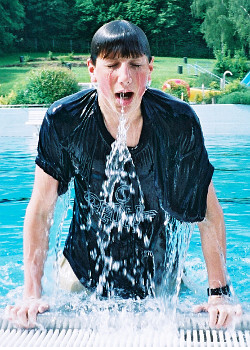
Push-ups are tough and get harder with more clothes.